
Why Website Speed Is Critical for
Hotel Success in 2026
The hidden factor that affects direct bookings, Google rankings, guest experience, and revenue.
Your Hotel Website Has Less Than 3 Seconds to Make an Impression
A potential guest discovers your hotel through Google.
They click your website expecting to see beautiful room photos, attractive rates, and a seamless booking experience.
Instead, they are greeted by a loading screen.
Three seconds pass.
Four seconds.
Five seconds.
Before your homepage even finishes loading, they return to Google and visit another hotel.
Most hotel owners never see this happen.
There is no notification, no warning, and no email telling you that a potential guest just left.
The booking opportunity simply disappears.
This is why website speed has become one of the most important factors in modern hotel marketing.
A Hotel Website Is No Longer a Digital Brochure
Many hotels still treat their website as an online brochure.
A place to display photos, facilities, and contact information.
However, today’s hotel website serves a much larger purpose.
It is:
- Your direct booking channel
- Your digital sales representative
- Your first guest touchpoint
- Your marketing platform
- Your most profitable source of reservations
Unlike Online Travel Agencies (OTAs), every direct booking generated through your website allows you to retain full control over the guest relationship and avoid commission fees. But none of that matters if visitors leave before your website loads.
Why Guests Expect Instant Loading
Modern travelers have become accustomed to fast digital experiences.
Whether browsing social media, shopping online, or booking flights, users expect websites to respond immediately.
When they encounter a slow hotel website, they often assume:
- The website is outdated
- The booking process may be unreliable
- The hotel lacks attention to detail
- Another hotel may provide a better experience
This perception may not be fair, but it happens every day.
In hospitality, first impressions matter.
Your website is often the first interaction a guest has with your brand.
Slow Websites Reduce Direct Bookings
Every second of delay creates friction in the booking journey.
Imagine a visitor trying to:
- View room categories
- Compare accommodation options
- Check availability
- Browse restaurant facilities
- Explore destination information
- Complete a reservation
When pages load slowly, users become frustrated and abandon the process.
For hotels that rely on direct bookings, this directly impacts revenue.
Even a small improvement in website performance can increase conversion rates and reduce booking abandonment.
Website Speed Is a Critical Ranking Factor for Hotel SEO
Website speed is not just about delivering a better experience for guests—it also plays a significant role in how search engines evaluate and rank your website.
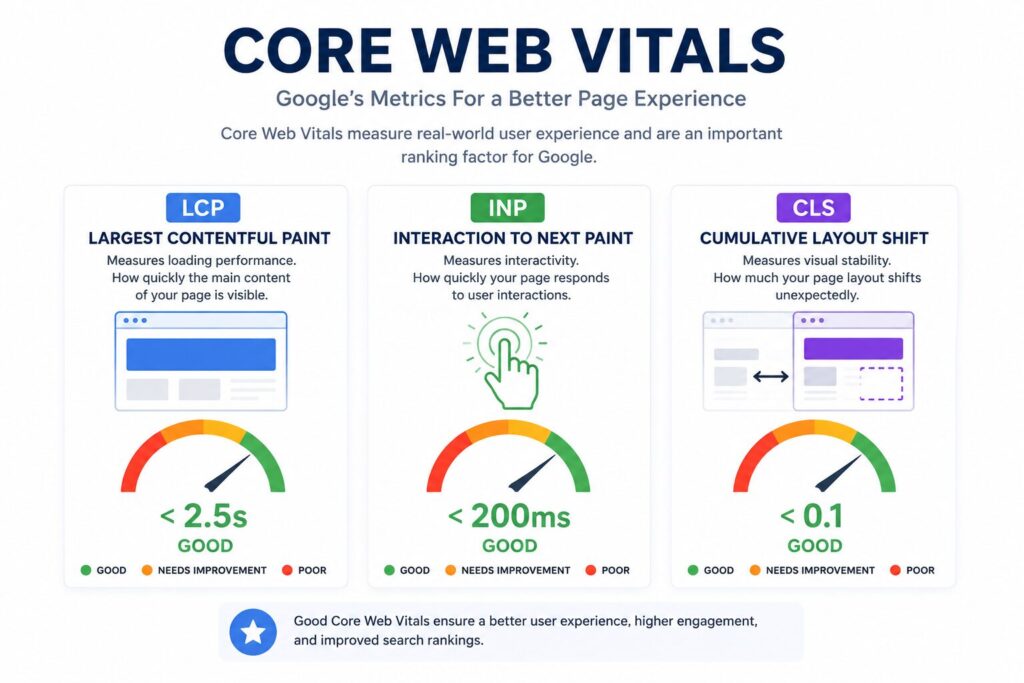
Google uses a variety of page experience signals, including Core Web Vitals, to measure website performance and user satisfaction. A fast-loading hotel website helps search engines understand that visitors can access information quickly and efficiently, resulting in a better overall experience.
A well-optimized website can contribute to:
- Higher user engagement and longer session durations
- Lower bounce rates and reduced visitor abandonment
- Faster and more efficient search engine crawling
- Improved mobile usability and accessibility
- Stronger organic search visibility
- Increased opportunities for direct bookings
While website speed alone will not guarantee a #1 ranking on Google, poor performance can limit the effectiveness of every other SEO effort. Even the best content, strongest backlink profile, and most comprehensive hotel marketing strategy can struggle to achieve their full potential if the website loads slowly.
Many hotels invest heavily in content creation, digital advertising, photography, and social media marketing, yet overlook one of the most important foundations of online success: website performance.
A slow-loading website can cause potential guests to leave before viewing room categories, exploring facilities, or checking availability. From Google’s perspective, these negative user signals indicate that the website may not be providing the best possible experience.
For hotels competing in today’s digital landscape, website speed is no longer just a technical consideration—it is a competitive advantage. Faster websites create happier visitors, stronger SEO performance, and more direct booking opportunities.
Simply put, a faster hotel website helps both guests and Google find exactly what they are looking for.
Mobile Performance Is More Important Than Ever
Most hotel searches now occur on mobile devices.
Travelers browse hotels while:
- Sitting in airports
- Traveling between destinations
- Exploring local attractions
- Comparing accommodation options
Mobile users often rely on unstable or slower internet connections.
A website that performs reasonably well on desktop may become frustratingly slow on mobile.
For this reason, mobile optimization should be considered a priority rather than an afterthought.
A fast mobile experience often leads to:
- Increased booking conversions
- Longer session durations
- More room views
- Higher engagement
Common Problems That Slow Down Hotel Websites
After auditing numerous hospitality websites, several recurring issues appear consistently.
Oversized Images
Hotel websites rely heavily on photography.
Unfortunately, many websites upload images directly from professional cameras without optimization.
A single image can exceed several megabytes.
When dozens of these images appear on a page, loading times increase dramatically.
Poor Hosting Infrastructure
Even a beautifully designed website can perform poorly when hosted on inadequate servers.
Cheap hosting environments often struggle with:
- Traffic spikes
- Large image libraries
- Dynamic booking systems
- Multiple simultaneous visitors
Performance begins with a reliable hosting foundation.
Excessive Third-Party Scripts
Many hotels integrate multiple services, including:
- Booking engines
- Chat widgets
- Analytics tools
- Marketing trackers
- Review platforms
Each additional script adds requests and processing time. Over time, these integrations can significantly affect website performance.
Unnecessary Animations
Animations can enhance design when used strategically. However, excessive visual effects often create unnecessary delays, particularly on mobile devices. The goal should always be user experience, not visual complexity.
Lack of Performance Optimization
Many websites launch successfully but never receive ongoing optimization.
Without regular maintenance, websites gradually become slower as:
- New content is added
- Plugins accumulate
- Scripts increase
- Media libraries expand
Website performance should be monitored continuously.
The Real Cost of a Slow Hotel Website
Most hotel owners focus on visible expenses.
Advertising.
Photography.
OTA commissions.
Marketing campaigns.
However, website speed often creates hidden costs.
When a slow website causes visitors to leave:
- Marketing budgets become less effective
- SEO performance suffers
- Direct bookings decline
- OTA dependency increases
These costs are rarely measured, yet they can significantly impact profitability over time.
Core Web Vitals and Hotel SEO
Google introduced Core Web Vitals to measure real-world user experience.
The three primary metrics include:
Largest Contentful Paint (LCP)
Measures how quickly the main content becomes visible.
Target:
Under 2.5 seconds
Interaction to Next Paint (INP)
Measures responsiveness when users interact with the website.
Target:
Under 200 milliseconds
Interaction to Next Paint (INP)
Measures responsiveness when users interact with the website.
Target:
Under 200 milliseconds
Cumulative Layout Shift (CLS)
Measures visual stability during page loading.
Target:
Below 0.1
When these metrics perform well, visitors enjoy a smoother browsing experience and search engines receive positive quality signals.
How Fast Should a Hotel Website Be?
For modern hospitality websites, the recommended targets are:
| Metric | Recommended Target |
|---|---|
| Initial Load Time | Under 3 Seconds |
| Largest Contentful Paint | Under 2.5 Seconds |
| Interaction to Next Paint | Under 200ms |
| Cumulative Layout Shift | Below 0.1 |
| Mobile Performance Score | 90+ |
Achieving these benchmarks creates a significantly better experience for both guests and search engines.
Speed Optimization Best Practices for Hotels
Hotels seeking better performance should focus on:
Modern Image Formats
Using WebP images can significantly reduce file sizes while maintaining visual quality.
Responsive Image Delivery
Different devices should receive appropriately sized images rather than downloading unnecessarily large files.
Content Delivery Networks (CDN)
A CDN helps deliver content faster to visitors regardless of their location.
Efficient Caching
Caching reduces server processing requirements and improves page loading times.
Code Optimization
Removing unnecessary CSS and JavaScript helps reduce page weight and improve performance.
Lazy Loading
Images and videos should load only when users are ready to view them. This improves initial loading speed significantly.
Speed Is a Competitive Advantage
In competitive destinations, guests often compare multiple properties before booking.
If your competitor’s website loads instantly while yours takes several seconds, the decision becomes easier for the traveler.
The faster website often wins.
Not because it has better rooms.
Not because it offers lower prices.
But because it delivers a smoother digital experience.
Final Thoughts
A hotel’s website is one of its most valuable business assets.
It influences:
- Search visibility
- Guest perception
- Direct booking performance
- Revenue generation
- Brand credibility
Website speed is no longer a technical luxury.
It is a business necessity.
Hotels that invest in performance create better guest experiences, stronger search rankings, and greater opportunities for direct bookings. In an increasingly competitive hospitality industry, every second matters.
Ready to Improve Your Hotel Website Performance?
Whether you’re operating a boutique villa, luxury resort, beachfront hotel, or hospitality group, website speed optimization can unlock significant improvements in SEO, user experience, and direct bookings.
Devata Pixel specializes in high-performance hotel website design and development focused on speed, Design, and conversion-driven user experiences.